In conversation with Antoine Jourdan
Antoine Jourdan, an art furniture creator, designer and art agent, has developed an approach grounded in the dialogue between art, design and craftsmanship. Through this conversation, Antoine shares more about his multidisciplinary journey and the experiences that have shaped his practice.
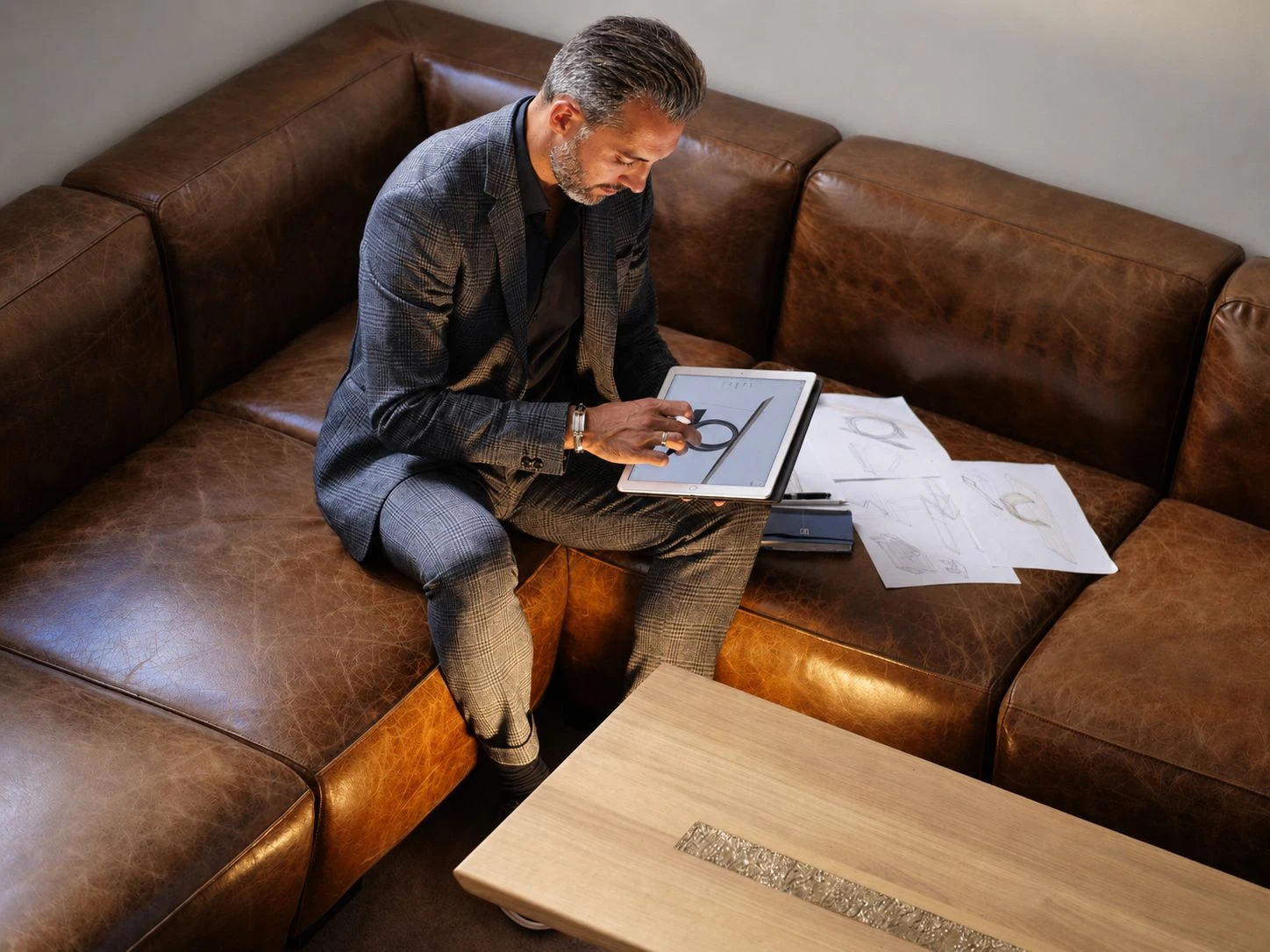
Interview published in AMY’s August 2026 newsletter.
If you were to introduce yourself today through your career, who is Antoine Jourdan, and what thread connects all your experiences, from craftsmanship to retail and luxury?
Above all, I have always been drawn to beautiful things, but even more so to the people who know how to make them. I grew up in an environment where craftsmanship and commerce played an important role. From an early age, I understood that behind an object, a piece of furniture, a jewel or a work of art, there is first and foremost a hand, a technique, a story and a human relationship.
I then gained my first professional experiences in Italy and in various European countries before joining Louis Vuitton at the age of twenty, initially in Saint-Tropez, then in Cannes and Paris. After three years with the Maison, I joined Gucci in Cannes. Those years in the luxury industry were immensely formative: they taught me the importance of exacting standards, attention to detail, the quality of the client relationship, but also how to articulate the story behind a product, a material or a savoir-faire, and give each its rightful place.
In 2016, I founded my own company to bring together everything I had learned and devote myself fully to what had long been at the heart of my interests: art, artists and design. The common thread throughout my career is therefore connection: a connection with a savoir-faire, a personality, a material, a client or a place. I enjoy creating bridges between worlds that might not otherwise meet. This is what led me to become both a creator of art furniture and an artists’ agent. Ultimately, my work is about bringing together creativity, craftsmanship and the perspective of the person who will live with the work.
Where does your sensitivity to art and design come from? Was there a particular encounter, artist, object or moment that sparked this passion?
This sensitivity goes back a long way. It certainly stems from my childhood in the world of craftsmanship and commerce, and from being surrounded by people who make, transform and invent. I have always been sensitive to materials, proportions, objects with a strong presence, and forms of craftsmanship that cannot simply be replicated through industrial production.
But there was one encounter that truly changed many things for me: meeting the ceramicist Georges Pelletier. Discovering his world, his studio, his approach to working with clay and, above all, his creative freedom was decisive. He had an immediately recognisable identity, a deeply personal body of work, and at the same time an extraordinary richness of forms and possibilities. This encounter made me want to take things further: not merely to champion an artist’s work, but also to imagine how their universe could enter into dialogue with other forms of craftsmanship and give rise to new creations.
This is, in particular, where part of my approach to art furniture emerged: not simply to juxtapose different skills, but to create a genuine conversation between them. Georges Pelletier’s ceramics, metal, wood, bronze, the craftsmanship of a Maison such as Tournaire… each material and each discipline must retain its own identity while contributing to a shared work.

You are simultaneously a creator, designer and artists’ agent. What exactly is your role with the artists you represent? How do you support their development and the dissemination of their work while preserving the singularity of their practice?
For me, being an artist’s agent is first and foremost about being a link. The artist must be able to remain focused on what they do best: creating. Yet there is an entire world to manage around them: collectors, galleries, exhibitions, commissions, individual requests, communication, logistics, collaborations, and sometimes the production or publication of certain works. My role is to connect the artist with this wider ecosystem.
I therefore present their work, respond to clients, organise or seek out exhibitions, support commissions, develop opportunities for their work to reach new audiences and, above all, identify the right people and institutions with whom to engage. It is not simply a matter of selling a work. One must know how to explain the work, tell its story, provide points of reference and convey what makes it unique. A collector does not simply acquire an object: they enter into a universe.
The other essential dimension is respecting the artist. There is no universal commercial formula that can be applied to everyone. Some artists enjoy communicating extensively, while others prefer not to. Some are eager to collaborate, while others need to protect their creative space more carefully. It is therefore important to find, together with them — whenever possible, as this is not always straightforward — the right ways to bring their work to the forefront without distorting it. This might take the form of an exhibition, a meeting with collectors, a collaboration with a Maison, a presence in a particular setting, or simply the ability to speak about their work accurately and thoughtfully.
I see my role as that of a mediator: protecting the artist’s singularity while creating the conditions for their work to encounter the wider world.
What are the three keys you would give a newcomer to help them appreciate art and design?
The first would be to look before trying to understand. We are sometimes intimidated by art because we believe we need to know art history, movements or techniques before we are entitled to an opinion. I believe the opposite: we should begin with our own response. Does the work attract me, unsettle me, intrigue me, make me want to move closer? Our first encounter with art should be free.
The second would be to experience the material and, whenever possible, meet those who create. Entering a studio, understanding how a ceramic piece is shaped and fired, how metal is worked, how a piece of furniture is constructed or how a painter develops their practice can completely transform the way we look. We cease to see only the finished object and begin to perceive the time, mastery and choices it embodies.
The third would be not to follow value, fashion or other people’s opinions blindly. We must learn to develop our own eye. A work can be important because it stays with you, because it provokes an emotion, or because it introduces you to an entirely new world. For me, appreciating art and design is above all about remaining curious: looking extensively, comparing, asking questions and accepting that our tastes evolve. What matters most is developing a personal relationship with what we see.